



Executive Summary
Report Period: January 19, 2026 – January 25, 2026
Published By: AscendEX Research Institute
Author: Bin Huang, Head of AscendEX Research Institute
1. Editorial: Asset Resilience Under Geopolitical Fire & The Redefinition of "Safe Haven"
This week (January 19–25, 2026), the global crypto asset market underwent a textbook "macro stress test." If the bull run of 2025 was a feast fueled by liquidity easing and ETF approvals, the opening theme of 2026 has indisputably shifted toward the intricate entanglement of geopolitics and macroeconomics. We stand at a historic inflection point: crypto assets are no longer merely shadows of the NASDAQ but are beginning to seek their own independent pricing logic amidst the fissures of global trade friction.
As observers at the AscendEX Research Institute, we witnessed a week of profound volatility. US President Donald Trump’s tariff threats regarding Greenland's sovereignty acted as a sudden "Black Swan," instantly piercing the psychological defenses of global capital markets. This event was not just a challenge to the traditional trade system but the ultimate litmus test for Bitcoin’s status as "Digital Gold."
From Monday’s (Jan 19) plunge, where Bitcoin briefly broke below $92,000 triggering a massive $875 million liquidation cascade, to mid-week (Jan 21) when Trump softened his stance at Davos—citing a "framework for a future deal" with NATO—sparking a retaliatory rebound, and finally to the weekend’s consolidation amidst the TikTok entity formalization and regulatory noise. The candlesticks this week charted not just price, but the electrocardiogram of global capital oscillating between panic and greed under uncertainty. We must lucidly recognize: Bitcoin is completing a complex metamorphosis from a "High-Beta Risk Asset" to a "Geopolitical Hedge." During this week's turbulence, despite BTC price pressure, we observed a significant increase in the correlation between Gold and Bitcoin. Moreover, at peak panic, Bitcoin did not capitulate like traditional tech stocks but demonstrated immense structural support.
However, the divergence in on-chain data—continuously declining active addresses versus the awakening of a 12-year dormant whale selling—warns us: this is not a unidirectional path to new highs. The process of leverage cleansing and chip redistribution is far from over. Structural differentiation within the market is intensifying: on one side, South Korea’s passage of the Security Token Offering (STO) bill marks a substantial leap for Asia in the Real World Asset (RWA) sector; on the other, the breakout of the ZK (Zero-Knowledge) sector, particularly Boundless (ZKC) leveraging the Bitcoin network to settle Ethereum proofs, reminds us again: regardless of macro noise, technological innovation remains the only hard currency to traverse bull and bear cycles.
In this edition of AscendEX Web3 Weekly, we strip away the emotional noise to dismantle the truth behind this tumultuous week with hardcore data and deep logic.
2. Market Overview: The Liquidity Game in Panic
2.1 Core Global Metrics & Sentiment Mapping
As of January 25, 2026, the total global cryptocurrency market cap has retraced to $2.98 Trillion, shrinking approximately 5% from last week’s high of $3.14 Trillion, and down 1.17% in the last 24 hours. This shrinkage was not uniformly distributed but showed clear "risk-off" characteristics: capital fled high-volatility altcoins, retreating to Bitcoin or moving directly into stablecoins to wait on the sidelines.
Market sentiment metrics experienced a roller-coaster shift. While the market was in "Greed" territory last week, the realization of tariff threats caused the Crypto Fear & Greed Index to plummet to 23 (Extreme Fear) by Sunday. This drastic shift (from neutral ~50 directly to freezing point) indicates that current market leverage remains high, and participants are extremely sensitive to macro policy shifts. Extreme fear often signals a local bottom, but without a positive catalyst, sentiment repair will take time.
Here is a snapshot of this week's core asset performance:
2.2 Macro Capital Flows: The Institutional vs. Retail Disconnect
This week’s capital flows presented an intriguing "disconnect":
- ETF Flows: Contrarian Institutional Thinking Despite the early-week price crash, US Spot Bitcoin ETFs did not record massive net outflows for the week as a whole. Conversely, certain days saw net inflows. BlackRock (IBIT) and Fidelity (FBTC), in particular, maintained stable inflows even during moments of panic. This demonstrates that mature institutional capital is utilizing panic to accumulate chips at lower prices for long-term allocation. They no longer view BTC merely as a speculative tool but as a necessity in portfolios to hedge against fiat credit risk.
- Stablecoin Flows: Offshore Risk Aversion On-chain data shows USDT market cap holding high at ~$185 billion (near 69% dominance), driven largely by offshore and retail funds. USDC sits at ~$64 billion with slight redemption signs. The Tron network continues to dominate USDT transfer volume. This indicates that against the backdrop of Trump's tariff threats triggering depreciation expectations for non-US currencies (like the Euro and Pound), global retail traders and merchants are hoarding USDT as a substitute for dollar assets to hedge against local currency devaluation. This explains why the total stablecoin market cap did not shrink significantly despite falling token prices.
3. Headlines Deep Dive: Dismantling Black Swans & Institutional Dividends
3.1 The "Greenland Crisis": A Stress Test Under Trump's Tariff Stick
Full Event & Timeline:
The week’s biggest macro Black Swan originated from President Trump’s "Twitter Diplomacy." Over the weekend of Jan 17-18, Trump threatened a 10% punitive tariff on 8 European nations (including Denmark, Sweden, Germany, France, UK) regarding the purchase of Greenland, threatening to hike it to 25% by June unless Denmark agreed to sell.
- Jan 19 (Mon): News fermented, and Asian markets opened to a crash. Crypto, highly sensitive to global trade friction, took the first hit. BTC dived from above $95k to near $91k in 24 hours, liquidating $875 million in leverage. The market feared a trade war would tighten global liquidity and trigger a chain reaction of equity sell-offs.
- Jan 21 (Wed): The situation turned. After meeting NATO Secretary General Mark Rutte at Davos, Trump announced a "framework for a future deal" and stated that due to good progress, tariff threats would be suspended. The market immediately staged a retaliatory rebound, with BTC recovering some losses.
AscendEX Deep Insight:
- Validation of Asset Duality: This crash revealed Bitcoin’s current awkward dual positioning. While the long-term narrative is "Digital Gold," in the initial phase of a geopolitical shock, it behaves like a high-beta tech stock, falling alongside NASDAQ futures. However, notably, when the tariff threat was lifted, BTC’s rebound was significantly faster than the S&P 500. During the panic, the correlation between Gold and BTC rose significantly to 0.28 (a yearly high), suggesting the market is subconsciously repricing BTC as a safe-haven asset.
- EU’s "Trade Bazooka" & The De-Dollarization Narrative: Facing Trump's threat, the EU threatened to deploy its Anti-Coercion Instrument (ACI). This weaponization of trade between sovereign powers undermines the trust foundation of the existing fiat system in the long run. For the crypto market, every crack in fiat credit is a long-term bullish signal for decentralized assets. This event reinforced Bitcoin’s strategic reserve value as "non-sovereign money."
3.2 South Korea STO Law: Asia's RWA Moment
Full Event: On January 23, the South Korean National Assembly officially passed amendments to the Capital Markets Act and Electronic Securities Act, legalizing Security Tokens (STO). The new law allows qualified issuers to directly issue and manage securities via Distributed Ledger Technology (DLT) without relying solely on the centralized Korea Securities Depository (KSD). The law is set to take effect in January 2027.
AscendEX Deep Insight:
- A Global Benchmark for Institutionalization: This is the first time a major Asian economy has legitimized STOs at the national statutory level. Unlike the US, where regulatory ambiguity is caused by SEC "Regulation by Enforcement," South Korea has taken a clear "Legislation First, Institutionalization" path. This provides a clear template for global regulation: how to integrate blockchain technology into the traditional capital market system rather than trying to stifle it.
- Opening a Trillion-Dollar Market: Stimulated by this news, tokens closely related to the Korean market and the RWA sector remained resilient this week. Korean financial giants like Mirae Asset Securities and Hana Financial have clearly stated they will pilot on-chain asset issuance. This means assets worth hundreds of billions of dollars—real estate, copyrights, debt—are expected to enter the DeFi ecosystem via tokenization, bringing real, sustainable yield to the crypto market. This is not just bullish for RWA but a potential growth point for the entire public chain ecosystem's TVL.
3.3 TikTok US Entity Reborn & The Oracle Alliance
Full Event: To beat the divestiture deadline and comply with US regulatory requirements, TikTok announced the formation of "TikTok USDS Joint Venture LLC." This joint entity is co-owned by Oracle, Walmart, and UAE investment firm MGX, with Oracle responsible for taking over US user data security. President Trump signed an executive order greenlighting this deal, allowing TikTok to continue operating in the US.
AscendEX Deep Insight:
- Implicit Bull Case & Payment Imagination: While technically an M&A deal in the tech sector, given Oracle’s close ties to the Musk and Trump inner circles, and Trump’s pro-crypto stance, the payment layer of the new TikTok entity holds immense speculative potential. The market has begun to speculate whether the future TikTok US will integrate stablecoin payments or SocialFi functions. MGX, representing Middle Eastern capital, also has business intersections with the Trump family's crypto project, World Liberty Financial. These intricate connections fill the market with anticipation for TikTok becoming the gateway for Web3 Mass Adoption.
4. Hot Sectors: Local Bull Markets Driven by Tech Narratives
While the broad market retraced, specific sectors and tokens decoupled, driven by strong "narrative gravity" and capital concentration. The market is rewarding technical innovations that solve core pain points (like Bitcoin scalability, cross-chain interoperability).
AscendEX Research Institute View:
This week’s Alpha was entirely concentrated in "Hardcore Tech Narratives." ZKC’s surge proves the market is fatigued by the fragmentation between Bitcoin and Ethereum ecosystems and is hungry for fusion solutions; ENSO’s success validates that "Intent-Centric" infrastructure is moving from concept to implementation, solving the pain point of Web3 complexity. For investors, focusing on infrastructure protocols that solve cross-chain fragmentation and improve capital efficiency is key to catching the next 100x gem.
5. On-Chain Data: Hidden Worries & Opportunities in Divergence
5.1 Bitcoin Activity Warning: Bearish Divergence Signal
According to the latest data from Glassnode and IntoTheBlock, the Active Addresses on the Bitcoin network continued a downtrend this week, hitting recent lows. Meanwhile, Bitcoin price remains oscillating in a high range.
- Deep Analysis: This is a classic Volume-Price Bearish Divergence. Sustainable bull markets are typically accompanied by synchronous growth in on-chain activity, representing an influx of new users. The current divergence suggests that recent price support comes mainly from passive institutional ETF buying and existing fund PvP (Player vs Player), rather than large-scale new retail organic adoption. This structure is fragile; if institutional buying pauses, the market lacks organic support, prone to deep corrections.
5.2 Whale Awakening: Profit Taking After 12 Years
Lookonchain detected a "Prehistoric Whale" address (labeled 5K BTC OG) waking up this week after 12 years of dormancy to conduct massive transfers and sales.
- Action Tracking: This address accumulated 5,000 BTC in 2012 at a cost of ~$332 per coin. This week, it transferred and sold ~2,500 BTC to Binance, cashing out nearly $265 million, with gains exceeding 30,000%.
- Market Psychology Impact: While $265 million in sell pressure is digestible for the Bitcoin market, the exit of such a "Prehistoric Whale" shocks market psychology. Participants interpret this as: even the most steadfast long-term holders believe the current price has reached a local top worth cashing out. This signal may trigger looseness among other long-term holders.
5.3 Stablecoins: Offshore Party vs. Compliant Stagnation
- The Great Split of USDT vs USDC: This week, USDT issuance outpaced USDC significantly. USDT flowed heavily into the Tron network, where transfer volume far exceeds Ethereum. This indicates that speculative and payment demand in non-US regions (Asia, LatAm) remains robust, and USDT’s status as "Shadow Dollar" is unshakable. Conversely, against the backdrop of the White House vs. Coinbase regulatory conflict, USDC growth has stagnated, showing the caution of US domestic compliant capital.
6. Financing Roundup: Infrastructure is King, Apps are Cold
Despite secondary market volatility, primary market fundraising remains hot. Crypto startups raised approximately $362 Million this week. The flow of capital is clear: Heavy on Infrastructure, Light on Apps.
AscendEX Observation:
VCs are cautious on pure Web3 games or social apps but are aggressively funding bridge projects connecting TradFi and Crypto (like BitGo, Superstate). This foreshadows that the main theme of 2026 remains "Institutionalization" and "Compliance."
7. Regulation & Macro: Rule Reshaping in the Game
7.1 US: The "CLARITY Act" Stumble & Regulatory Tug-of-War
A clash between the White House and Coinbase over stablecoin regulation has jeopardized the support for the highly anticipated CLARITY Act. The act intended to provide a clear framework for stablecoin issuance, but provisions regarding whether stablecoins can offer yield became the point of contention. Banking lobbyists oppose non-bank institutions (like Circle, Tether) issuing yield-bearing stablecoins, viewing it as a threat to traditional bank deposits. This directly impacts the compliance prospects of combining DeFi protocols with stablecoins and explains USDC’s recent sluggish growth.
7.2 Brazil: Central Bank Issues New VASP Rules
Brazil’s Central Bank issued detailed guidelines for crypto companies this week, requiring all Virtual Asset Service Providers (VASPs) to establish local entities and undergo strict Anti-Money Laundering (AML) audits. This raises compliance costs for international exchanges operating in the region but secures long-term market legitimacy. As the largest crypto market in LatAm, Brazil's regulatory stance will have a demonstration effect on the entire South American region.
7.3 Macro Data: Strong GDP & Delayed Cuts
Strong US GDP and jobless claims data this week imply no recession is imminent. This also means the probability of a Fed rate cut in late January is near zero. The "Higher for Longer" expectation is being repriced, acting as a glass ceiling for risk assets. The market must adapt to finding new narratives in a high-rate environment, rather than relying solely on liquidity easing.
8. Chart Analysis: Quantitative Perspective on Bull/Bear Forces (Coinglass)
(Note: Based on Coinglass derivatives data)
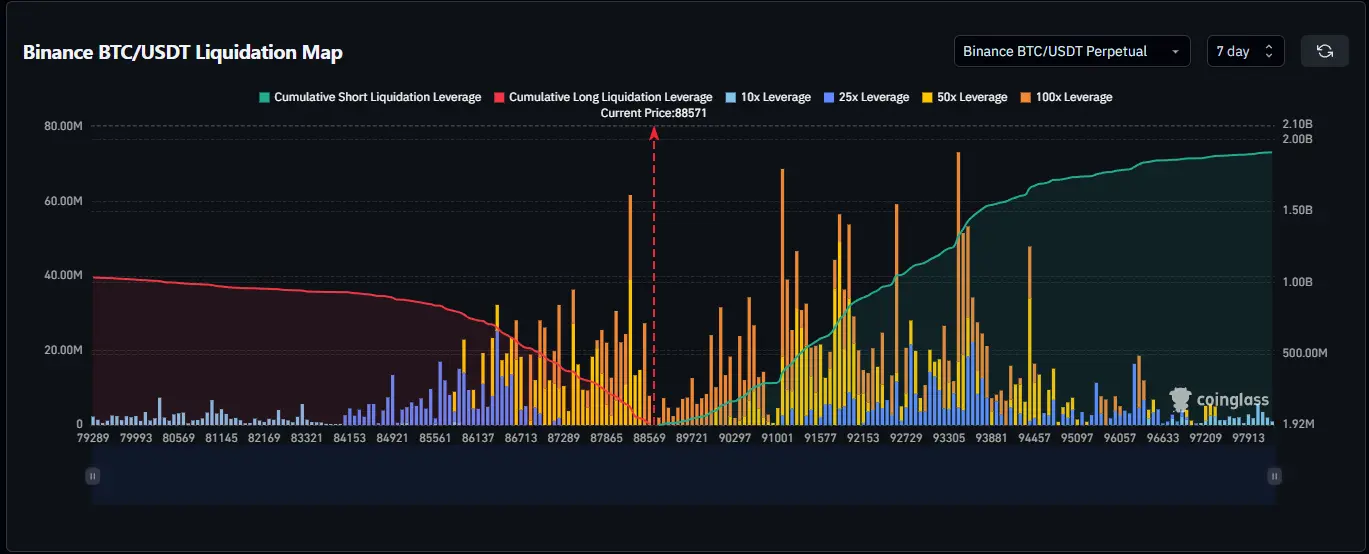
8.1 BTC Liquidation Heatmap
- Overhead Resistance (Pain Points): Massive short liquidation clusters are concentrated in the $95,500 and $98,000 zones. If price rebounds, these levels will be heavy sell-pressure zones and potential targets for market makers to "hunt" liquidity.
- Downside Support (Pain Points): Long liquidation clusters are dense at $87,200 and $85,000. Price testing the $88,000 line this week is essentially market makers testing the liquidity depth of this zone. A valid break below $87,200 could trigger a Cascade Liquidation, sending price directly to $85,000.
8.2 Funding Rates
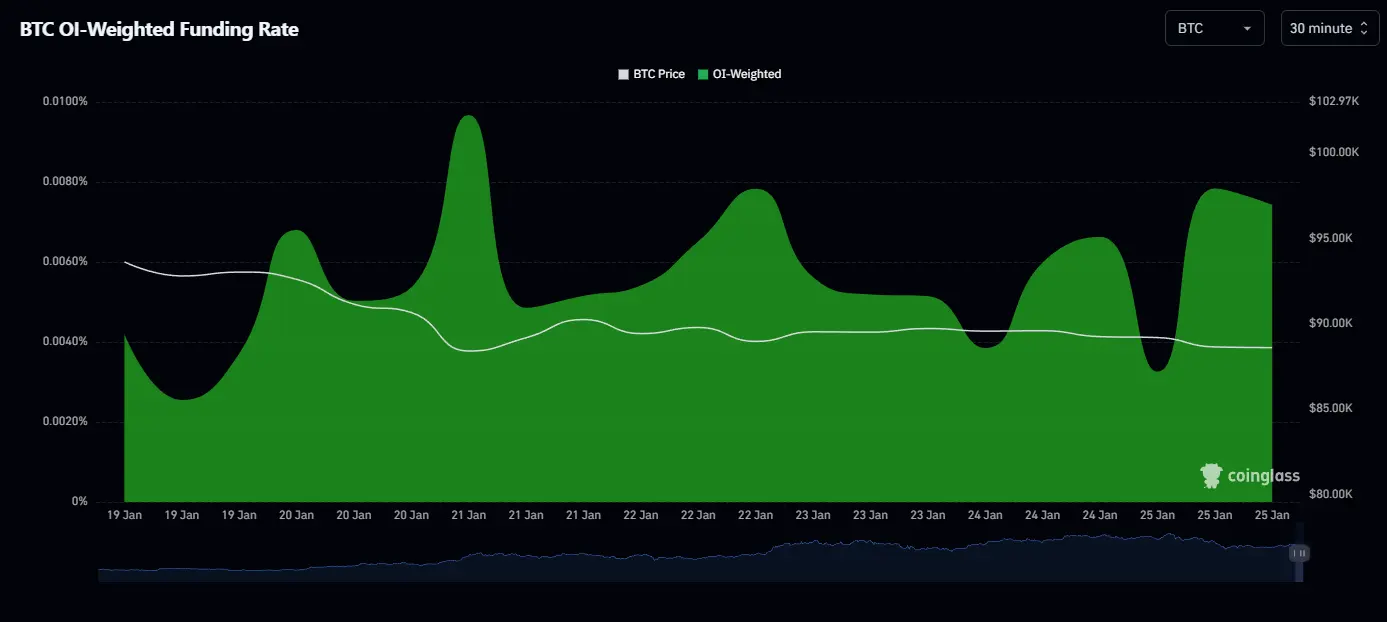
- Global weighted funding rates briefly turned negative (panic moments) during the price crash early in the week but quickly returned to positive. Currently maintaining the 0.01% baseline level, indicating a balance between bulls and bears with no obvious short squeeze or long squeeze signs. The market is in an awkward "relay pattern," waiting for direction.
8.3 Open Interest (OI)
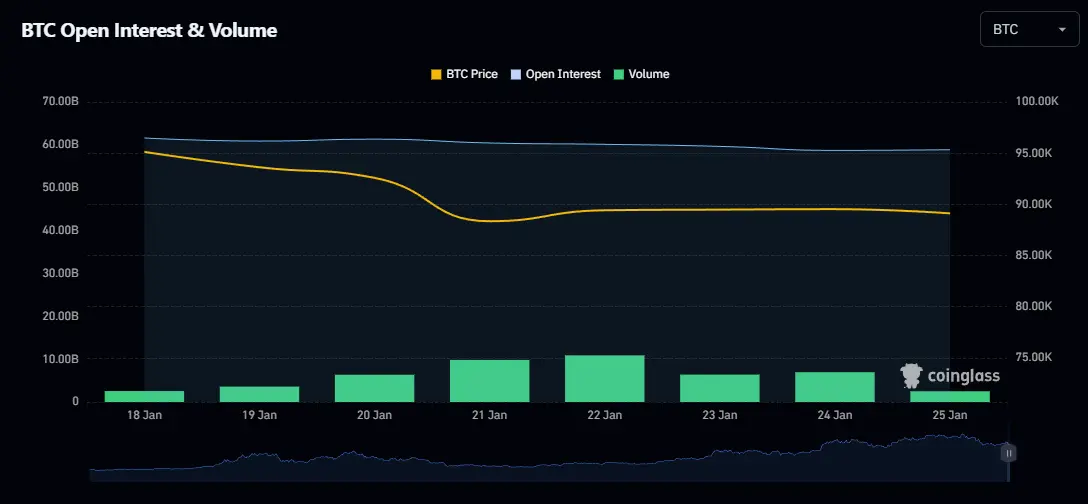
- BTC Open Interest (OI) plummeted on Monday but began a slow recovery by Wednesday, currently around $58.8 billion. Notably, OI is growing faster than the price rebound, meaning new short positions are being built. If price cannot quickly break $92,000, these new shorts may dominate the next round of dumping.
9. Next Week Outlook: Unlock Waves & The Eve of FOMC
9.1 Key Events Warning
- Jan 26 (Mon): Bitget (BGB) Massive Unlock
- 140 Million BGB will unlock, valued at approx $504 Million, representing 20% of circulating supply.
- Deep Analysis: This is a massive sell-pressure test. Historically, exchange token unlocks of this scale are often accompanied by severe price volatility before and after the event. While some tokens belong to the team and marketing and may not be dumped immediately, the market often "drops first out of respect." Holders are advised to hedge, and speculators can watch for a post-unlock panic dump to potentially catch a "Golden Pit" entry.
- Jan 29: Pre-FOMC Positioning
- Although the meeting is at the end of the month, next week enters the final game before the blackout period. The market will rehearse Powell's potential hawkish or dovish stance. With strong economic data, maintaining rates is expected; the key lies in the Dot Plot's guidance for the future.
9.2 Trading Strategy
- Spot: Placing ladder buy orders in the $85,000 - $88,000 zone for BTC is a relatively safe strategy; this is a high-odds left-side entry zone. For altcoins, aside from ZKC and ENSO which have independent tech narratives, it is advised to avoid them temporarily, as the Bitcoin Vampire Effect is likely to persist.
- Derivatives: The R/R for longs is poor here. A better strategy is to look for rejection short opportunities near $93,000, or engage in volatility arbitrage (long volatility) around the BGB unlock event.
Final Word:
The wind rises before the storm. The Greenland tariff scare this week may just be the prelude to 2026’s macro volatility. In this market, survival precedes profit. Respect leverage, embrace technologies that truly build the future.